How Much Does a Retaining Wall Cost in Pennsylvania?
Most people pay $3,500 to $9,400 for a retaining wall, according to a national cost guide updated in December 2025. That guide puts the national average at $6,300. Small jobs can cost as little as $1,200, and large jobs as much as $13,700. By the square foot of wall face, retaining wall cost runs $20 to $53 for most walls.
For block retaining wall cost, a national cost calculator starts a short wall at $35.41 to $48.62 per square foot. That figure covers a non-structural interlocking block wall no higher than 3 feet above grade. A second national guide, updated in June 2026, reports a typical range of $3,192 to $9,208. Its average is $6,085.
These are national market numbers, not our price list. On a Pike County lot, retaining wall installation cost moves with rock, water, access and height.
What does a retaining wall cost per square foot?
Cost guides price a wall by the square foot of its face, which is the length times the height. The December 2025 guide breaks that price out by material.
| Wall material | Typical cost per square foot |
|---|---|
| Interlocking block | $15 to $35 |
| Landscape block | $15 to $60 |
| Natural stone | $20 to $90 |
| Poured concrete | $20 to $40 |
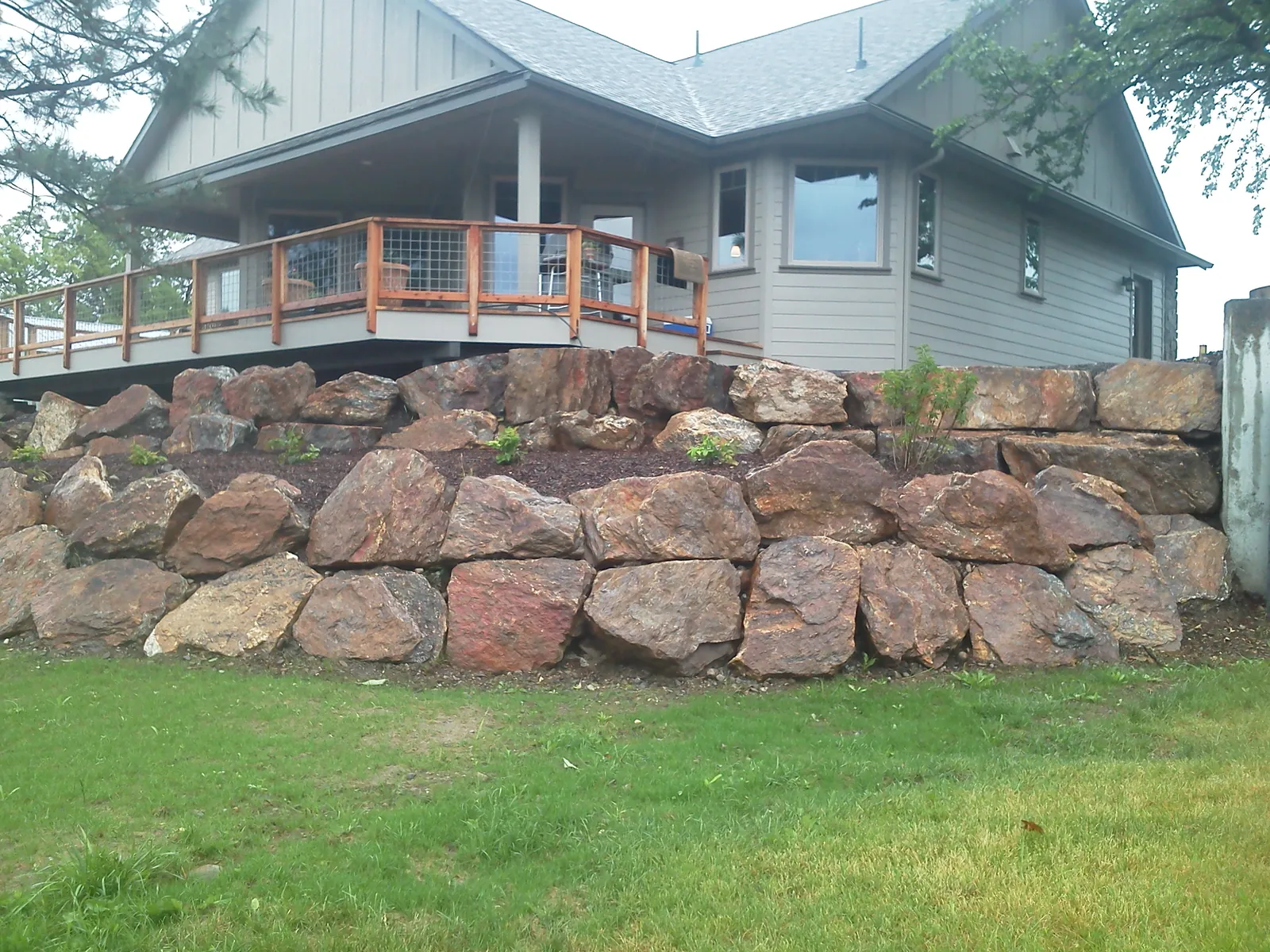
Sawkill Environmental builds block and boulder retaining walls. The poured concrete row is market context only, and boulder walls get their own figure. A stone wall guide from the same publisher as the second guide prices a boulder or stone retaining wall at $3,650 to $6,420 in total. Its average for that wall is $5,025.
Why does the ground under the wall change the price?
Every wall needs a firm base. Topsoil and soft ground come out along the wall line. Crushed stone goes in and gets compacted in layers. How much work that takes depends on what sits under your lot.
Most of Pike County is in the Glaciated Low Plateau Section. The US Geological Survey (USGS) describes it as rounded hills and valleys shaped by glaciers. Building on a hill means cutting into it, and a retaining wall holds the cut.
USGS reports that less than half the county has glacial deposits over the rock. Most of those deposits are till, typically less than 6 feet thick. Bedrock is exposed at the surface in many areas.
The deposits run thickest in the valleys and in a narrow band along the Delaware River. They are thinnest on the uplands, so a wall on an upland lot may reach rock within a few feet. When the bucket hits ledge, the dig turns into breaking rock, and that takes more machine time. Our post on what excavation and rock work cost covers those rates.
USGS also notes that swamps and peat bogs are common on the plateau. Wet, soft ground under a wall line has to come out before the base goes in. Every wall base starts with a call to 811, which reaches Pennsylvania One Call.
What do boulders and tight access add?
If the dig turns up boulders, each one has to come out of the wall line. For a boulder wall, ask whether stone from your own dig can go into it.
Access matters too. The second national guide says an easy site lets contractors use larger machines and cut labor time. Hard-to-reach areas may need more manual labor, which costs more. On a wooded lake lot, clearing trees and stumps may come first so an excavator can reach the wall line.
Why does a retaining wall need drainage behind it?
Soil behind a wall holds water after rain and snowmelt. That water is heavy, and it pushes on the back of the wall. In winter it can freeze and push harder.
The fix is washed stone behind the wall, with a perforated pipe at the bottom. The pipe carries water out to daylight or into a drain line. On a wet slope, it can tie into yard drainage and French drains for the rest of the lot. When you compare bids, check that each one includes the stone and the pipe.
What does grading above and below the wall add?
A wall changes how water crosses your yard. The ground above it gets shaped so water runs away from the wall. The ground below gets graded to a usable level.
The December 2025 guide says grading typically costs at least $500. The second guide lists land grading at $900 to $3,000. A wall for a building pad or a private road is one part of site preparation and grading.
How does wall height change the price?
The second national guide says a two-foot-high wall costs $40 to $200 per linear foot on average. A wall six feet high costs $360 per linear foot in the same guide.
That guide says walls over four feet tall need footings and reinforcement. It also lists a structural engineer at $350 to $750 for walls more than four feet high. The calculator figure up top covers only a non-structural block wall up to 3 feet.
Do you need a permit for a retaining wall in Pennsylvania?
Pennsylvania’s Uniform Construction Code lets some short walls go up without a building permit. The residential rules in 34 Pa. Code 403.62 exempt a retaining wall not over 4 feet tall. The 4 feet is measured from the lowest level of grade to the top of the wall.
The exemption does not cover a wall that supports a surcharge, meaning a load on the ground above it. It also holds only if the work does not violate a law or local ordinance. Taller walls fall outside it as well, so call your township before the dig.
Where a permit is needed, the December 2025 guide puts permit costs at $40 to $450. The fee varies by location. This is general information from the state code and a national guide, not legal advice.
How do you get a real price for your wall?
The ranges above make a budget. The real number comes from your lot, so we look at the site before we price a wall. We work about 25 miles out from Milford, in Pennsylvania and across the river.
Sawkill Environmental is based in Milford and builds retaining walls on hillside lots across Pike County. We run our own excavators and equipment, so the excavation for the base and the wall stay with one company. We are licensed and insured (PA HIC #PA225040), and estimates are free. Call or text (973) 552-8580.